Wednesday, 27 July 2011

Post-Modernism, Ai Weiwei and Banksy

1. Define Post-Modernism using 8-10 bullet points that include short quotes.

-A mixture of styles brought upon by modernism. "Instead of the reductive, minimalist style of Modernism, Postmodernism architecture is noticeable by its mixture of styles."(p.13 ALVC)

-A idea with bigger focus on decoration and variety. "it is possible to say that the ideology of Modernism was one of anonymity, of what was perceived as 'stylelessness'. The ideology of postmodern design is one of decoration and variety." (p.13 ALVC)

-New ways of thinking about art and culture. "ways of thinking that questioned long-established patterns and hierarchies.

- Expanding upon the range of contemporary arts "art practice was turned upside down by a new eclecticism which celebrated artistic and cultural diversity in contemporary art."

-Rejection of old ideology and a focus on new ones. "Postmodernism rejects the modernist ideals of rationality, virility, artistic genius, and individualism, in favor of being anti-capitalist, contemptuous of traditional morality, and committed to radical egalitarianism."

-a belief that what came before it realted to opressive ideaology."Post Modernism is an anti-Enlightenment position wherein adherents believe that what has gone before, as "Modernism", is inappropriately dependent on Reason, Rationalism, and Wisdom, and is, furthermore, inherently elitist, non-multicultural and therefore oppressive."

-A period of time after the 1980's to now that marked the end of modernism. "If Modernism is at an end, we are now facing a new period. The name given to this period is Postmodernism." (p.18 ALVC)

-A view that is seen to be Anti-Modern. "The seemingly anti-modern stance involves a basic rejection of the tenets of modernism; that is to say, a rejection of the doctrine of the supremacy of reason, the notion of truth, the belief in the perfectibility of man, and the idea that we could create a better if not perfect, society." (p.18 ALVC)

2. Use a quote by Witcombe (2000) to define the Post-Modern artist

"Whereas Modernism seeks closure in the form and is concerned with conclusions, Postmodernism is open, unbounded, and concerned with process and "becoming.""

3. Use the grid on pages 42 and 43 to summarize the list of the features of Post-
Modernity.
Postmodernism took what modernity taught us and rejected it in a way that brought upon new thinking  and ideology. People were able to be more open about what they do and explore new nontraditional ways of doing things. social diversity was unclear and cultures adapted to many forms of media. A mixture of cultures arose and hyper-reality became more powerful than the real reality. Art could be seen as almost anything.

5. Research Chinese artist Ai Weiwei's 'Han Dynasty Urn with Coca-Cola logo'(1994)
in order to say what features of the work are Post-Modern.

'Han Dynasty Urn with Coca-Cola logo'(1994), Ai Weiwei

Ai Weiwei dropping a Han Dynast Urn.

Weiwei's Coca-cola urn is a drastic change of an old historical urn into something new and exciting.
It breaks the boundaries of modernism by defiling a historical artifact with the well known Coca-cola symbol. By doing this he has merged together the western culture with that of ancient china. He has recycled cultural art with aspects of visual media that we can all relate to. The pop culture he has brought to this piece is what makes this work a part of post modernism.

6. Research British artist Banksy's street art, and analyze the following two works by the artist
to discuss how each work can be defined at Post-Modern.


'Flower Riot', Banksy

Flower Riot by Banksy first strikes us as being unusual and out of the ordinary. We see here a determined male rioter about to throw his weapon into enemy territory. Except his choice of weapon is what has made this image so post modern. We all know how riots work, maybe from experience but mostly through the eyes of the media. Banksy is challenging this idea by allowing the male figure to be throwing something normally never thrown, and with such force too. Is he going to bring harm or joy to his target? This image can be defined as post-modern because of how it questions this idea of power.

Los Angeles (2008), Banksy

Humans being the descendants of ape, or so some believe, is what we first see in this piece by Banksy. But wait, what is he holding? Thats right, fast food. Here we see a grown caveman-like male figure with what looks to be a fast food meal in his right hand, and a bone in his left. This piece is directly addressing the fact of human growth and how far we as a species have evolved over time. However by putting this growth into the hands of an aged caveman is how Banksy portrays the question of how far we have actually come. This unorthodox combination is why this work can be defined as post-modern.


 http://digital1.natlib.govt.nz/support/discover/va2essay.htm

http://www.naciente.com/essay15.htm

http://www.arthurimiller.com/journalism/the-worlds-of-ai-weiwei/

http://www.artzinechina.com/display_vol_aid109_en.html

http://dailyserving.com/2010/07/ai-weiwei-dropping-the-urn/

http://arnica.csustan.edu/carosella/banksystreetart/street_art_by_banksy.htm


http://virtualvisualmuseum.blogspot.com/2011/05/fast-food-caveman-by-david-dauteuil.html


Wednesday, 20 July 2011

Nathalie Djurberg's 'Claymations'.

1. What do you understand by the word 'claymation'?


Claymation is a type of film animation in which the artist constructs scenes/figures out of clay and uses a stop-motion technique to bring their works to life. Stop-motion is much like a flip-book animation where you have many different still frames with small differences between them, allowing movement to happen.


2. What is meant by the term 'surrealistic Garden of Eden'? and 'all that is natural goes awry'?


When i hear the phrase 'Garden of Eden' i think of a place that has reached absolute perfection. A place where nothing could go wrong, however when the garden has been portrayed with a 'surrealistic' point of view there is no telling what it could entail. This out of wack Garden of Eden is exactly what Djurberg has created and everything in it has become strange. With monstrous flowers towering over people and the lack of natural light in the atmosphere it is said to be a very nauseating experience. I think the sentences 'surrealistic garden of eden' and 'all natural goes awry' simply mean that this perfect garden of eden is now a place where anything could happen, and where everything you thought was natural, is now strange.


3. What are the 'complexity of emotions' that Djurberg confronts us with?

After watching one of her videos it is clear that there is indeed a vast amount of emotions being thrown at us all in a very short period of time. The scarceness of the dark and gloomy environment, the horror and disgust of what is happening to the clay actors, the anxiety and confusion of not knowing what is going to happen next. We are confronted with different types of the same emotion while also being immense amounts of sexual discomfort.


4. How does Djurberg play with the ideas of children's stories, and innocence in some of her work?
To me these 'ideas' of children's stories do not exist much, maybe it is because of how un-innocent the videos really are. However i admit that all the videos do resemble child-like television programs that would be played for kids under the age of 10. This is purely because of the vivid coloured, cartoonish style of claymation she has used which is also seen on television a lot in today's world.
5. There is a current fascination by some designers with turning the innocent and sweet into something disturbing. Why do you think this has come about?
I think artists these days have more options in the sense that they choose what they want to portray in their work rather than it being commissioned. A lot of the modern art that is surfacing today is more of just the artists trying to express themselves and their views to the world. I personally think one of the reasons for this change could be the constant strain we as humans are putting on the earth we live on. Sure we may live in a more civilized time but little by little we make the world become more disturbing due to all the industrial factories as opposed to it becoming more Eco friendly. 
6. In your opinion, why do you think Djurberg's work is so interesting that it was chosen for the Venice Biennale?
I think the reasons it was chosen are based around the intense amount of emotions and radical feelings we get as soon as we start watching one of Djurbeg's animations. An exhibition like this is highly unique and not seen very often. Also having the clay works around you while you are watching, making you feel like you are part of the atmosphere is all the more exiting.
7. Add some of your own personal comments on her work.
Djurbeg's work strikes me at first as something that came from the minds of people in some sort of mental asylum. It is only after looking past all the disgusting sexual displacement that I can fully understand many of the emotions that she is trying to portray. All in all it is not something i would normally want to view but, despite all its horribleness, i would still congratulate her for creating such masterpieces.
 References
http://www.designboom.com/weblog/cat/10/view/6886/nathalie-djurberg
http://we-make-money-not-art.com/archives/2009/10/nathalie-djurberg-who-won-the.php
http://www.designboom.com/weblog/cat/10/view/6886/nathalie-djurberg-experiment-at-venice-art-biennale-09.html
http://www.labiennale.org/en/Home.html
 http://www.rolloart.com/nathalie_djurberg/about  


Monday, 30 May 2011

Industrialisation, Modernism and architecture.


The Eiffel tower and the Guggenheim museum have both been labeled astonishing masterpieces of their time. I will explore the reasons for this while also comparing similarities and differences between the two.

The Eiffel tower is without a doubt one of the most famous pieces of man-made architecture created to date. Standing today at 1050 feet high it is the symbol of Paris and was completed in 1889. The structure was designed by a French bridge builder Alexandre Gustave Eiffel. This gives me reason to believe that this is the reason why it looks so bridge-like. The Tower is made from 15000 pieces of iron that cross one another diagonally as the ascend into the sky. The reason for its existence was to celebrate the French revolution at the world exposition in the 1800s. Many people hated the tower and thought of it as a building without skin. After a failed petition to bring it down the tower now stands in Paris in all its iron glory. Currently it is one of the most visited tourist attractions in Paris and the world.

A museum different from all the others in Spain known as the Guggenheim museum is easily one of the most interesting buildings of the 20th century. In a attempt to bring new light into a much industrialized Spain American architect Frank Gehry designed a sculpture-like building that was, and still is today, to be used as a museum of art. The building was designed to look like a ship while the pattern on the walls are fish scales. The structure is made from limestone, titanium panels and glass curtains. The limestone represents tradition while the titanium represents futuristic aspects.

Unlike the Eiffel tower, the museum was made to be used for many years after it was made. The Eiffel tower was originally a temporary project which was later kept instead of being destroyed. The towers structure is that of a pyramid whilst the museums has various free-formed segments connected to each other. Both structures are still used today as tourist attractions.

References

http://www.ionbee.net/travel/destinations/paris-france/eiffel-tower.php

http://www.redparis.co.nz/Facts-about-Eiffel-Tower__I.8033

http://jssgallery.org/essay/worlds_fairs/paris_exposition_1889/eiffel_tower.htm

http://www.galinsky.com/buildings/guggenheimbilbao/index.html

http://www.arcspace.com/architects/gehry/Guggenheim_Museum/

Landscape and the Sublime

1. What and when was the Enlightenment?
 
The Enlightenment was a movement that took place in the 18th century. It is a movement that intrigued humans to question and understand nature without turning to religious beliefs. Many philosophers wrote about politics, nature, economy, and morality all in order to understand more about the world during this time.

2. Define the concept of the Sublime.

In art the philosophy behind the term sublime dates back to late 17th century and early 18th century as a term some used to describe beautiful aspects of nature. Today sublime can be seen as anything beautiful, beyond, stunning, amazing, out of the ordinary, and a lot of other things.

3. How did the concept of the Sublime come out of the Enlightenment thought?

Before the Enlightenment in the 18th century most artist had a strong focus on religious paintings/sculptures. This was or could be due to many great art patrons being popes. However when the enlightenment arose the focus was much more on the aspects that shaped the world we lived in today. This allowed for artists to really capture the essence of a scenery or a art piece including landscapes for example.

4. Discuss the subject matter, and aesthetic (look) of Misrach's work to identify the Sublime in his work. Add some more images of his work.

The subject matter of most Misrach's work is heavily centered around landscapes. These two are both taken from bird's eye view looking down at the scenery. He has included some human figures in these works as well. I think he has done this to make us feel that even thought it looks like a beach some of us would only dream about being at, it is possible to be there. The work is calm and relaxed and has amazing colour.


5. Identify some other artists or designers that work with ideas around the Sublime, from the Enlightenment era as well as contemporary artists.

John Martin, a Sublime painter during the 18th century


Robert Marchessault a modern photographer and painter of the sublime


6. How does Misrach's photography make you feel? Does it appeal to your imagination?

The level of Misrach's work and how he manages to capture the essence of the scene is only bested by his reputation as a photographer. The astonishing landscapes that he captures are flooded with vibrant colour making me feel like I am actually there. Just looking at the shimmering water in the first photograph makes me want squint my eyes because of how bright it is.

7. Add a Sublime image of your choice to your blog, which can be Art or just a Sublime photograph.


8. Reference your sources (books and websites).

http://www.artinfo.com/galleryguide/20291/6826/6306/robert-mann-gallery-new-york/artist/richard-misrach/biography/

http://library.thinkquest.org/C006257/revolution/the_enlightenment.shtml

http://www.edelmangallery.com/misrach-bio.htm

http://www.amerindianarts.us/articles/concept_of_the_sublime_as_an_aesthetic_quality.shtml

http://mslinder.wikispaces.com/Sublime+Workbook

The social status of the artist


1. Identify aspects of Durer's self portrait that show a changing view of the artist's view of himself as an individual.

Painted in the early renaissance, Durer's secular portrait of himself shows us the way in which artists after the 14th century had a drastic change in the way they viewed them self. In the portrait we see a full-faced depiction of the artist Albercht Durer. One of the first techniques we notice is Durer's use of symmetry. His Hair, face and body are all symmetrically aligned in a way that only the gods and higher-ups were immortalized in back in ancient Greek and Roman times.  Another thing to point out is that the coat he is wearing is made of presumably real fur. This during the renaissance time was a common sign of wealth.

2. Explain how the artist's social status increased during the Renaissance period. Briefly explain why this happened.

The renaissance period was the beginning of a new era, literally meaning "rebirth", It sparked high interest in old Greek and Roman antiquity from the 14th all the way to the 17th century. Artists still produced a lot of Christian paintings during this time, however they were also able to focus on new and exciting ideas brought upon by old antiquity thought to be forgotten. The wealthy took advantage of these new found ideas and frequently hired artists to portray them via painting or sculpture in ways that related back to ancient Greek and Roman history. They became "patrons" of the arts. This movement allowed for artists to become widely sought after by kings, emperors, and many other wealthy patrons other than just by the church.

3. Comment on Gavin Turk's work in relation to individualism, status of the artist and egotism.

Individualism is an ideological concern that was brought about during the renaissance period. It is the idea of the moral worth of the individual and the control over our personal beliefs. Gavin Turk is a man who belives in the importance of ones self. This is why, in a way, he is similar to Durer as he has created a modern version of something that shows how egotistic he really is.


4. Comment on Damien Hirst's use of his work and the media for self promotion.

Damien Hirst's "Damien Hirst and Mia Norman" is an interesting piece of work, not only because of the content but because of the story behind how he became to be so self promoted. As with Hirst it was also true that many other young british artists after him were mostly seen to be very intependant. They were often seen for there entrupenurial aspects and knowledge of media. Hirst would often promote his own exhibitions and they would be relitively successful. I think this is what he is trying to show by having more of him in the image, and less of her(her body being camoflagued with the backdrop).


5. Find 2 images of work by artists or designers that reflects some of the ideas of individualism,
self promotion or egotism that have been discussed on this blog. Upload images to your blog, title and date the work, identify the artist/designer and comment on the work in relation to the question.


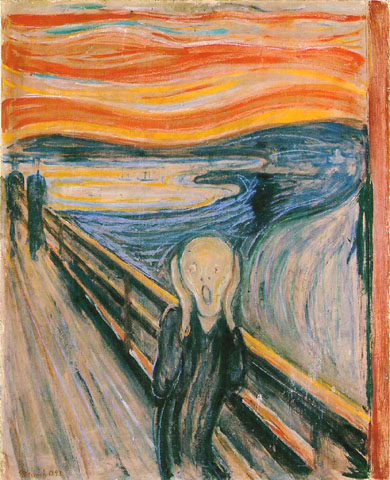
Scream by Edward Munch 1893

Munch's "Scream" is a very famous painting that has gained recognition in almost all corners of the world. The main reason for this is that everyone can react to it in different ways. It poses questions like"who are the figures in the painting?" and "What is the abstracted figure actually screaming about?". I personally think it has a lot to do with Munch's identify considering his past and that during the time of the painting his sister was in a mental asylum.


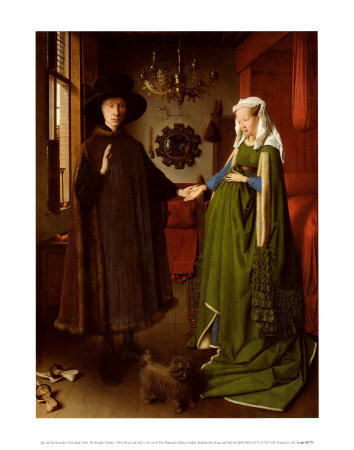
Arnolfini Portrait by Van Eyck 1434   

This is a painting of the Arnolfini wedding that was crafted in the early renaissance by a Belgium artist named Van Eyck. One reason this painting sparked great interest in its time period was that it was one of the first panels painted with oil. The other reason is that it is filled with everything that resembled a wealthy couple in the renaissance time period. It seems as thought the fur garments, expensive chandelier, and everything else that resembles wealth has had more attention added to them rather than the fact that they are getting married. They want you to know there rich. This shows the individualism of the Arnolfini's but Van Eyck has also shown his own egotism by putting his signature above the mirror on the back wall.


6. How do you think artists and designers are viewed in Western society today?

Artists in today's society have a lot more to consider than those of the renaissance period. They have a lot more aspects they can be judged on where as in older times a lot of things were done by way of the church. Having said that artists are also more sought after as industrialism continues to grow. They have a handful of medias at their disposal and i think they will continue to be sought after for a very long time.


7. Reference the websites and/or books you have used, at the end of your blog.

http://www.all-art.org/baroque/portrait12.html

http://academic.brooklyn.cuny.edu/english/melani/cs6/ren.html

http://www.britannica.com/EBchecked/topic/286303/individualism

http://www.skny.com/artists/gavin-turk/

http://www.artbible.info/art/biography/jan-van-eyck


Barbara Kruger


1. Describe the 'style' that Kruger has used in the two presented works.

Barbara Kruger, labeled by many to be a feminist artist, studied at Syracuse university where she developed her interest in graphic design and poetry. The result of this is that the two works shown are heavily influenced by her background in graphic media.
Kruger's art is done with a graphical approach. We can see this mostly by looking at the blocks of text and/or borders of the artworks. Although there are pop art influences and features in the works, the graphic style she has adopted is what really makes the works stand out from others of her time. The border and white box in 'I shop therefore I am' portray this well as it draws our eyes towards the main message of the image like an advertisement. 'Face It' also does this but has the added effect of a monochromatic design.

2. What are some of the concepts and messages that Kruger is communicating in them?

The messages these works communicate have a lot to do with the American idea of consumerism. This idea revolves around the desire/need to purchase and produce goods at large amounts. Take Kruger's play on the phrase 'I think therefore I am' for example. It is quiet obvious this work is trying to communicate a message with us, however, the message can be differently seen from different perspectives. It simply could be that it is the artists idea or view of how material possessions and consumerism were influencing life at that point in time, or something more complicated like Alan Foljambe's idea of "Shoppers are shopping for art which questions the wisdom of shopping for art which questions the wisdom of shopping. Welcome to the world of post-modernism" (The art of Barbera Kruger, 2010).

3. Do these images communicate these ideas effectively? Explain your answer.

The images by Kruger do a very good job of explaining the ideas of consumerism. This is because of the sheer simpleness of the image and the fact that graphical techniques used aid in getting us to acknowledge the meaning of her words. Kruger also pushes the importance of the words onto us by making the works very large. Standing in front of a 111 x 113 inch piece of work would leave you wondering no doubt.

4. Define the concept of Mercantilism and explain how these two examples can connect with the concept.

Mercantilism is a system that helped wealthy countries become more wealthy by means of overseas exporting. The idea was to export more than you imported in order to gain a larger income. Mercantilism brought about a lot of new ideas with it as well as the lust for precious metals such as gold. I believe that 'I shop therefore I am' connects with this idea in a way that makes people think about the amount of possessions people were actually buying at the time. While 'Face It' is more of a "well i have all this gold, i might as well buy it" sort of a thing.

5. Upload a more recent example of Kruger's work where she has used a new medium, that is not graphic design. Title your image of the chosen work and comment on your response to the work. How do you think the audience would experience this work?


Barbara Kruger
The Globe Shrinks
2010

This 2010 work by Kruger is a 13 minute, 3-way video loop that varies tremendously from her past works in terms of media used. Although it is a video it still aims to show the viewer "the kindness and brutality of the everyday" (Barbara Kruger “The Globe Shrinks” at Mary Boone Gallery 2010). Like her other works it is a mix between written and visual aspects. I think an audience or any viewer would be relatively overwhelmed walking into a room like this and seeing a three paneled video as huge as this one. It would make them think about various aspects of life as the video swapped between written words and visual pictures.


References:

http://www.arthistoryarchive.com/arthistory/feminist/Barbara-Kruger.html

http://slamxhype.com/art-design/barbara-kruger-%E2%80%9Cthe-globe-shrinks%E2%80%9D-at-mary-boone-gallery/


http://www.suite101.com/content/the-art-of-barbara-kruger-a240211

http://www.referenceforbusiness.com/encyclopedia/Man-Mix/Mercantilism.html

http://www.dukevisualstudies.org/artsvis54/?p=757